
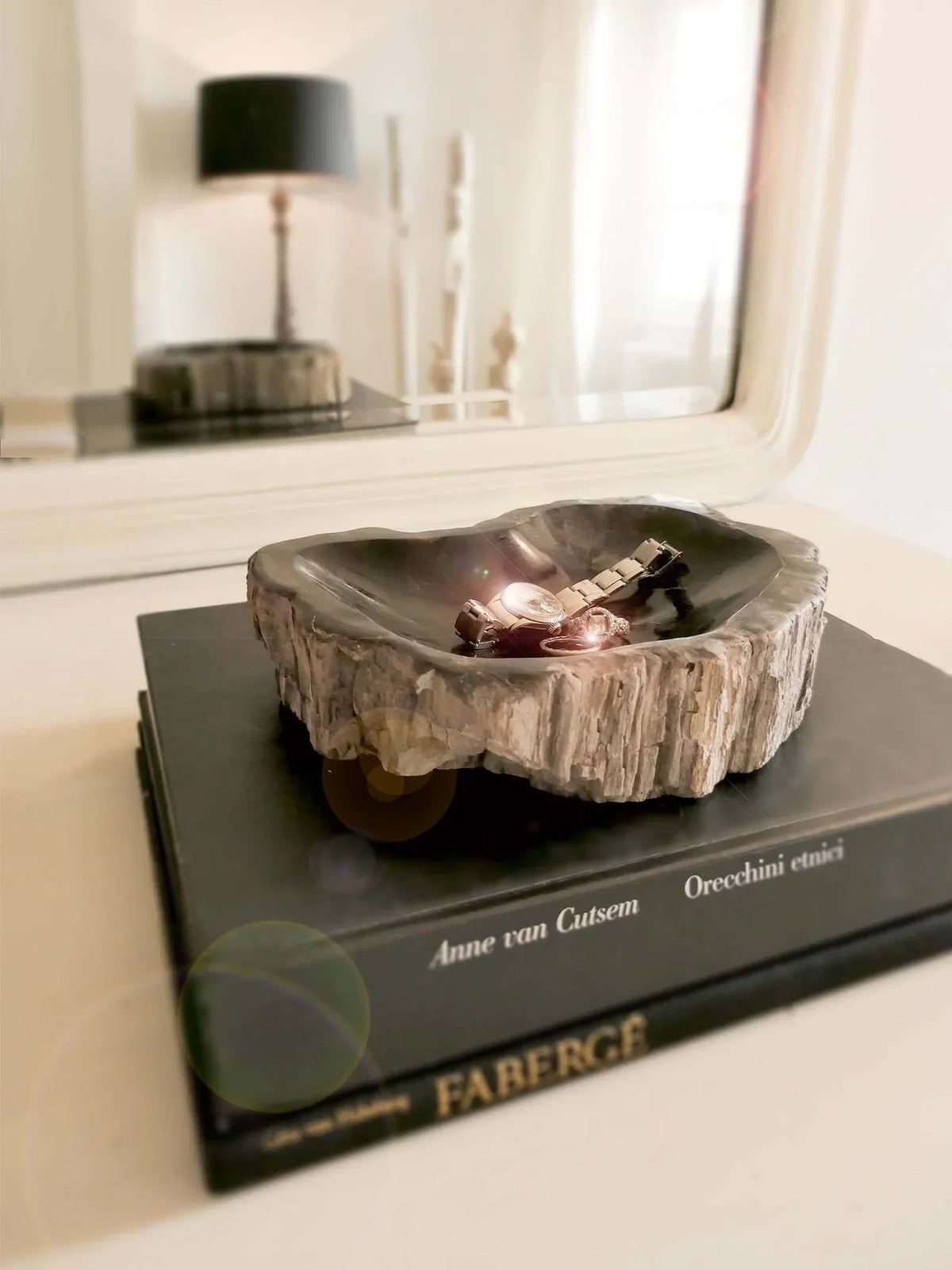
TOUT SAVOIR SUR LE BOIS PÉTRIFIÉ

Le bois pétrifié est constitué des restes fossilisés d’arbres et de plantes très anciens. Pendant des millions d’années, des minéraux ont progressivement remplacé la matière organique d’origine tout en préservant des détails tels que la texture de l’écorce, les cernes de croissance et la structure cellulaire. De nombreux spécimens indonésiens datent du Miocène et ont environ 20 millions d’années, tandis que le bois pétrifié provenant de régions comme l’Arizona peut dépasser 200 millions d’années. Le bois pétrifié est considéré comme une gemme et constitue la gemme officielle de l’État de Washington, aux États-Unis.
COMMENT LE BOIS PÉTRIFIÉ S’EST FORMÉ
Le bois pétrifié s’est formé lorsque des arbres préhistoriques ont été ensevelis sous des sédiments dans un environnement pauvre en oxygène, ralentissant leur décomposition naturelle. De l’eau riche en minéraux a ensuite circulé à travers le bois enfoui. Au cours d’un processus extrêmement lent appelé perminéralisation, des minéraux tels que la silice, la calcite et la pyrite ont rempli les pores et remplacé la matière organique tout en conservant la structure originale de l’arbre.
D’OÙ VIENT-IL ?
Des forêts pétrifiées et des gisements existent dans de nombreuses régions du monde, notamment en Grèce, aux États-Unis, à Madagascar, en Égypte, en Bolivie, au Canada, au Brésil et en Indonésie. Le bois pétrifié indonésien provient souvent d’arbres de la famille des Dipterocarpaceae, encore largement présente dans les forêts tropicales d’Asie du Sud-Est. On trouve également du bois de palmier fossilisé. Les spécimens d’Arizona et de Madagascar peuvent comprendre d’anciens arbres apparentés aux Araucarias, bien que de nombreuses autres familles d’arbres soient représentées dans le monde.
LA PALETTE DE COULEURS

L’aspect du bois pétrifié varie selon l’arbre d’origine, son âge et les minéraux présents lors de la fossilisation. Les pièces indonésiennes présentent souvent des tons neutres d’ivoire, de gris, de brun et de noir, tandis que certains spécimens américains révèlent des nuances rouges, bleues ou vertes. Le cuivre, le cobalt et le chrome peuvent contribuer aux tons verts et bleus ; le manganèse aux nuances roses ; les oxydes de fer aux rouges, bruns et jaunes ; le carbone et les oxydes de manganèse aux zones sombres ; et la silice aux tons blancs et gris.
COMMENT EST-IL UTILISÉ ?

Le bois pétrifié est souvent façonné tout en conservant le contour organique des troncs, branches et racines. De grandes scies et meuleuses servent à découper ce matériau semblable à la pierre, avant un façonnage et un polissage minutieux, exigeants et longs. Le polissage révèle les couleurs, le veinage et les motifs minéraux propres à chaque pièce. Parmi les objets les plus appréciés figurent les tables d’appoint, tabourets, serre-livres, bols, plateaux, dessous-de-plat, sphères décoratives et petites sculptures. Le matériau pouvant être cassant, il ne convient pas aux sculptures très détaillées.
POURQUOI CHOISIR DES ACCESSOIRES EN BOIS PÉTRIFIÉ ?
Le bois pétrifié réunit ancienneté géologique, durabilité et beauté naturelle. Aucune pièce ne présente exactement la même couleur, le même motif ou la même silhouette, ce qui rend chaque objet véritablement unique. Sa présence sculpturale s’intègre aussi bien aux intérieurs contemporains et minimalistes qu’aux décors plus riches, auxquels elle apporte de la texture et un lien tangible avec l’histoire profonde de la nature.
CROYANCES TRADITIONNELLES ASSOCIÉES AU BOIS PÉTRIFIÉ
Dans certaines traditions spirituelles et liées aux cristaux, le bois pétrifié est associé à l’ancrage, à la stabilité, à la patience et à la résilience. On lui attribue parfois la capacité d’encourager l’évolution personnelle, la confiance pendant les périodes de changement, la prospérité et l’harmonie relationnelle. Ces associations relèvent de croyances culturelles et spirituelles et ne constituent pas des effets scientifiquement établis.
COMMENT NETTOYER ET ENTRETENIR LE BOIS PÉTRIFIÉ

Avec quelques gestes simples, le bois pétrifié peut conserver sa beauté pendant de nombreuses années :
- Évitez les produits chimiques agressifs, les nettoyants abrasifs, les brosses dures et les matières rugueuses.
- Pour l’entretien courant, utilisez de l’eau tiède et essuyez délicatement la surface avec un chiffon doux en microfibre ou en coton lisse.
- Utilisez le moins de produits possible.
- Si l’eau ne suffit pas, appliquez une petite quantité de nettoyant doux au pH neutre, après l’avoir testé sur une zone peu visible.
- Essuyez immédiatement l’huile, le vin et le café, car les liquides peuvent pénétrer dans les petits pores et laisser des taches.
- Une exposition prolongée à une lumière solaire intense peut progressivement atténuer les tons foncés ; les pièces très sombres conviennent donc généralement mieux aux intérieurs.

Ecrit par Sandra Kirschon


2 commentaires
Guten Morgen,
vielen Dank für Ihre Nachricht. Die Sorge um Umwelt und Ökosysteme ist absolut verständlich. Genau deshalb ist es wichtig zu präzisieren, dass versteinertes Holz (petrified wood) nicht aus aktuellen Rodungen oder lebenden Wäldern stammt.
Es handelt sich um sehr alte Baumstämme, die vor Tausenden oder sogar Millionen von Jahren auf natürliche Weise umgestürzt sind und vollständig mineralisiert wurden. In den Regionen, in denen versteinertes Holz gesammelt wird, tritt das Material häufig bereits an der Oberfläche oder in Flussbetten zutage, etwa nach Regenfällen oder natürlichen Bodenbewegungen. Es werden keine Bäume gefällt und keine Wälder zerstört.
Die Sammlung erfolgt selektiv und von Hand, ohne industrielle Grabungen, ohne chemische Verfahren und ohne Eingriffe in bestehende Ökosysteme. In vielen Gebieten ist diese Tätigkeit lokal geregelt und bietet den dortigen Gemeinschaften eine nachhaltige Einkommensquelle, die deutlich schonender ist als andere Formen der Rohstoffgewinnung.
Aus ökologischer Sicht gilt versteinertes Holz als nachhaltiges Material, da es keine heutigen natürlichen Ressourcen verbraucht, keine energieintensiven Industrieprozesse erfordert und vorhandene Materialien aus geologischen Zeiträumen sinnvoll nutzt.
Vielen Dank für Ihre Aufmerksamkeit und freundliche Grüße.
Kirschon
Guten Morgen, ich finde es mehr als bedenklich, wenn die Menschen jetzt auch noch anfangen, die Erde für fossiles Holz aufzureißen und auszurauben, nur um sich davon etwas als Dekoration hinzustellen. Ich würde gerne wissen, wie dieses Material in den tropischen Regionen zugänglich gemacht wird. Sicher nicht, ohne die Ökosysteme dort zu zerstören. Oder haben Sie andere Informationen dazu? Danke und freundliche Grüße
Anna Winters
Laisser un commentaire
Ce site est protégé par hCaptcha, et la Politique de confidentialité et les Conditions de service de hCaptcha s’appliquent.